Fall 2012 Success…VOTE for Active Minds to win $1 Million!

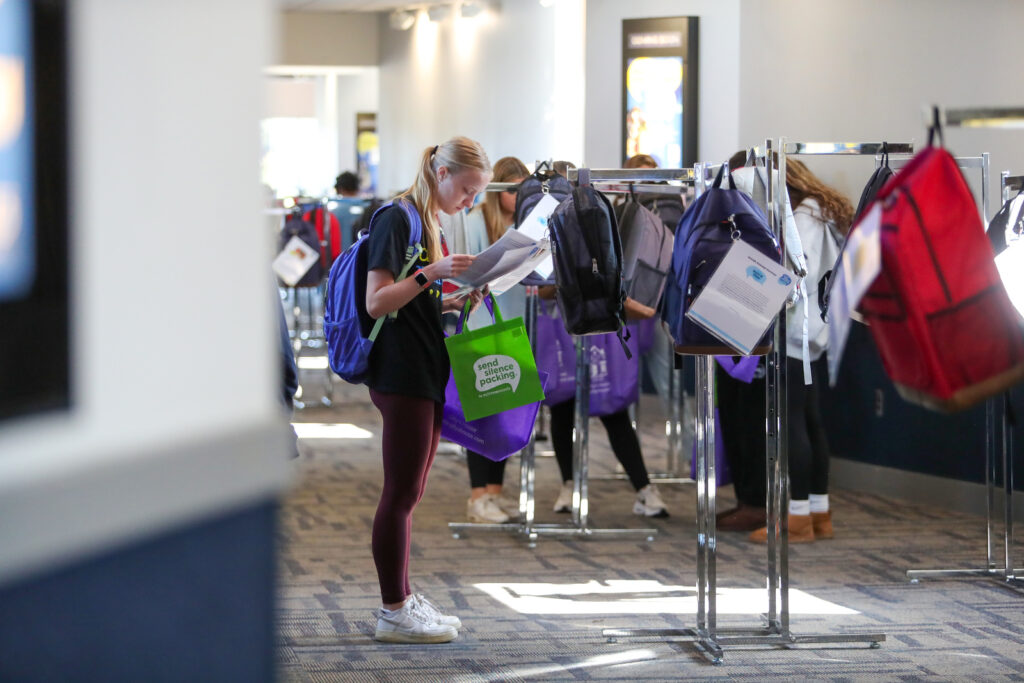
Many thanks to all of our supporters for yet another successful Send Silence Packing tour! We completed our first venture through the southern region of the US, hosting displays as far west as McKinney, Texas, and as far south as Orlando, Florida. We reached thousands of individuals in 11 unique locations; among the locations were 2 HBCUs (Historically Black Colleges and Universities), 2 community colleges, and downtown New Orleans.

We worked with familiar faces – Josh Anderson Foundation – and met new allies in the fight for suicide prevention – Bob Sleppy at Nuçi’s Space and David Anderson of Survivor to Hero. We also had the opportunity to connect with individuals who support the efforts of the Active Minds chapter on their campuses and in their community – Barry Bryant at UNC Chapel Hill; Cary Israel, President of Collin College; and Brian Loughmiller, Mayor of McKinney, TX.

Based on material distribution and conversations had while on the road, we likely reached over 50,000 people with our message! All of this thanks to the hard work of our host campuses and chapters who were a part of bringing Send Silence Packing to their community.

While we celebrate the success of this powerful program and prepare for yet another round of campus tours for the 2013-2014 school year, I would also like to take some time to present this important call to action. See the message below to learn more about how you can help Active Minds win $1 Million to continue programming like Send Silence Packing.

If you could save a student’s life – wouldn’t you?  What if all you had to do was cast an online vote?  Active Minds needs your help to make this happen!

Active Minds, Inc., dedicated to creating a world where no person dies by suicide and ensuring that no student is left struggling with their mental health alone, has been selected as one of 25 charities in the race to win $1,000,000 through the American Giving Awards presented by Chase. We’re approaching the last days of the competition (voting ends tomorrow, December 4 at 11:59pm EST) and we need your help to get the word out.

Please take 15 seconds to vote for Active Minds and share the link with your friends.

You can VOTE by following these four easy steps:

  1. Go to www.voteactiveminds.com.
  2. Click on the blue VOTE button.
  3. Click “allow application.”
  4. Click “go to application.” DO NOT click “close”
  5. Again, click on the blue VOTE button.
  6. Vote and share with your friends.

You will know if you voted if you see the “thank you screen” and if there is a check-mark next to “voted” on the Active Minds voting page.

We hope that you will join us by liking the Chase Facebook page, voting for Active Minds, and then asking everyone in your network to do the same. Individuals can only vote once, which is why we are relying on the power of sharing to get the word out about our organization and earn as many votes as possible. The more people you can share it with, the better.

Mental health issues are real, they impact all of us, and Active Minds is transforming the way society talks about the issues so no one is left struggling alone. Visit us at www.voteactiveminds.com, click on the blue “Vote” button and submit your vote today!

If you are a Chase customer you can also vote by visiting www.chasegiving.com, clicking on the “Health & Wellness” category and selecting Active Minds.

Thank you in advance for your support. Your vote and your voice will help us save lives!

UCF / 2012 Active Minds Mental Health on Campus Conference

We wrapped up the tour with a Send Silence Packing display at the 9th annual Mental Health on Campus conference at the University of Central Florida in Orlando.

We thought we’d do something a little different for this display, and so we asked Active Minds chapter members and visitors to share their experiences with Send Silence Packing, Active Minds, and Mental Health. Check it out below:

FAMU

We’ve seen so much momentum for mental health on campuses throughout our Southern US tour! The energy continued during our extremely lively display at Florida Agricultural and Mechanical University. The warm Florida weather and active campus community ensured that we had plenty to talk about throughout the event.

Two things stood out to be about this display: The interest in personal stories/family history, and questions. These two overlapped quite a bit as well, and we heard several students asking an important question: what can I do to make sure my family is ok?

This is a fantastic question, and luckily, an answerable one. As we emphasize during our city displays, the information we provide, while focuses on college students, applies to everyone. Mental health is ubiquitous—it’s something we all share. We may be at different parts of a spectrum at any given time, but we all have the capacity to be a part of the conversation. One visitor spent quite a bit of time at our resource table before asking how she could get information about how to learn about her Uncle’s schizophrenia. She mentioned about how she knew almost nothing about it growing up because her family refused to acknowledge it. However, by taking the step to ask questions this day, she was able to walk away with information on how to learn more about what was affecting her family.

As we near the end of another tour, the display at FAMU was an important reminder that we need to continue having these conversations and discovering the tools to talk about mental health throughout all of our communities, whether it’s your school, your workplace, or your family.

Emory

Send Silence Packing was back in Georgia for our stop at Emory University. Students from Decatur’s chapter were also at the display for the first half of the day. 

Emory’s campus was full of students and professors that were interested in taking pictures of the display. The students from Decatur were snapping photos during set-up and making sure to document every part of their experience. There were also several people that came by, spent a lot of time reading the backpacks, and took pictures of the display. Seeing so many people do this reminded me of what it was like to experience Send Silence Packing for the first time. Now that I am on my third tour (and Brandon on his fifth) we are constantly excited about interacting with people that come to the resource tables to ask questions and share stories. I think we sometimes forget the experience we had seeing the display for the first time because we are so eager to interact with students walking by.  

People will often comment on how overwhelming it is to see the back packs. Once they hear what they represent and how many young people we are losing each year, it takes a moment for people to collect their thoughts. It is one thing to hear the statistic that 1,100 college students lose their lives to suicide each year and a whole different thing to process seeing that many back packs. It is a great feeling to be a part of their experience and to help students change the conversation about mental health on their campus. Send Silence Packing makes a very serious and powerful statement while inspiring people to change the way they view mental health and suicide.

We received a lot of support throughout the day, and realized how important of an impact we made near the end of the display. We were short on volunteers when we started pack-up, but we had students stop what they were doing to help us. They had seen the display earlier and were eager to lend a hand. Working with Active Minds has been a constant reminder of what a difference we are making in the lives of people that we interact with. For all of the people that we were able to talk to, there are several more that were impacted my our message. Getting help from the students was a refreshing act of kindness that meant a lot to us when we needed the help. We hope to give the same message to anyone that we reach during our displays.

University of Alabama

Who knew Alabama would be so windy! Heading towards the final stretch of our southern tour, we set up Send Silence Packing at the University of Alabama in Birmingham. We were challenged by a few abnormally large wind gusts (one of which was strong enough to send a table onto its side), but this didn’t stop students from visiting the event. 

We had a lot of opportunities at this display to talk with visitors about the language of mental health. One question that kept coming up was “I have a friend that has been acting differently, but I know they wouldn’t want me to ask them about it—what do I do then?” Starting the conversation can certainly be a challenge, but that doesn’t make it any less important.

This is a difficult answer, because the right way to go about it is going to be different for every person. When someone is struggling with their mental health they can certainly feel vulnerable and defensive when confronted. However, in most cases, regardless of how the individual initially reacts, talking to them WILL have positive results—even if they don’t show it right away. Simply knowing that someone is there for them can plant the seed to them opening up and facing what they need to face to become healthy again.

We have a responsibility to be there for the people around us when we’re able. It may be challenging, and the answer of how to approach as certain situation may not be clear at first, but it’s important to remember that reaching out will never do more harm than good.